


With the sustained growth of the Indian economy and a consequent rise in the purchasing power of Indian consumer during the last few decades, the demand of milk and milk products in the country has been buoyant and this trend is expected to continue in the long run also as India is slated to become third largest economy in the World soon.
To sustain the pace of dairy development in the country, it is essential that all efforts are made with a synergistic approach and focussed towards achieving growth and sustainability of the dairy sector. To make the sector future ready, we now need to focus more on various aspects of dairying to sustain this growth along with improving livelihood for crores of our farmers. Dairying can contribute significantly in the Vision 2047, a vision for India becoming a developed nation by 2047. In order to identify the main thrust areas, a workshop was organized for brainstorming and zeroing on the focus areas and developing a Vision 2047 for dairying. A diverse group of stakeholders including dairy professionals, academicians, researchers, scientists, government and practitioners deliberated on the theme.
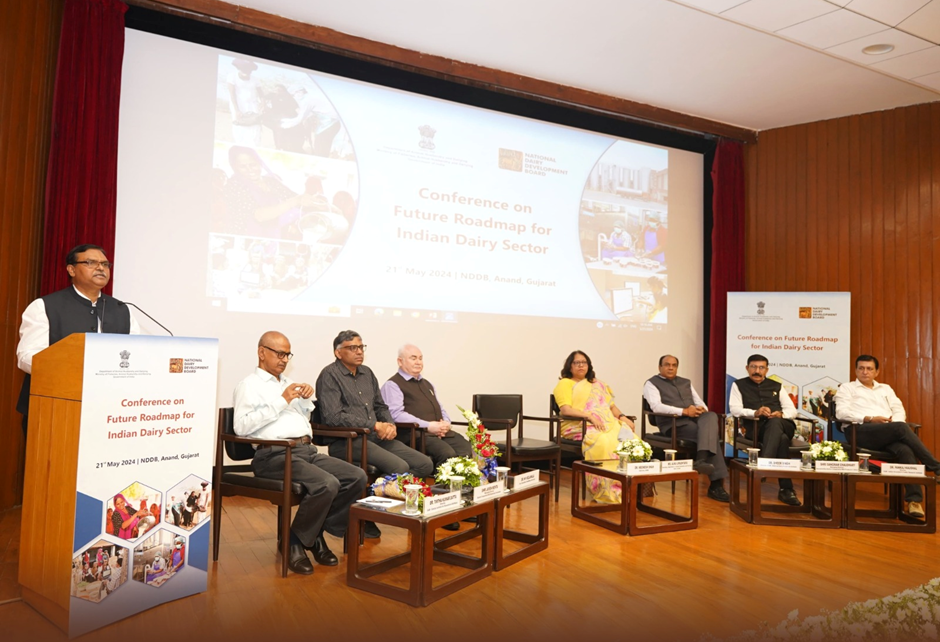
The conference on the Future Roadmap for the Indian Dairy Sector was inaugurated by Ms. Alka Upadhyaya, Secretary, DAHD, MoFAH&D in presence of Dr Meenesh Shah, Chairman, NDDB, Dr. NH Kelawala, Vice Chancellor of Kamdhenu University, Dr. Dheer Singh, Director of ICAR-National Dairy Research Institute, Shri Sangram Chaudhary, MD Banas Dairy, Shri Jayen Mehta, MD of GCMMF, Dr. Tirtha Kumar Datta, Director, Central Institute for Research on Buffaloes, ICAR, Dr. Pankaj Kaushal, Director of ICAR-Indian Grassland & Fodder Research Institute and other distinguished dignitaries of the Indian dairy sector.
Secretary, DAHD, Ms. Alka Upadhyaya highlighted several key interventions necessary for enhancing the Indian dairy sector. She emphasised the importance of effective livestock health planning, vaccination, and improved nutrition practices to significantly boost animal productivity. Additionally, she proposed that both the cooperative and private sectors can achieve rapid growth by leveraging each other’s strengths, thereby strengthening the organised dairy sector. Ms. Upadhyaya stressed the need for value addition and infrastructure development for milk processing to meet domestic consumption demands.
Chairman, NDDB in his welcome address highlighted the importance of this assembly of policymakers, decision-makers, and research institutes. He emphasised that the conference serves as a platform for experts to brainstorm and outline the future pathway for the dairy sector. He praised India's transformation from a milk-deficit nation to the world’s largest milk producer and expressed hope for the inception of White Revolution 2.0. Dr. Shah stressed the need for value addition in milk and its products to ensure competitive remunerative prices for farmers. He also underscored the importance of sustainability, which can elevate India’s standing on the global stage. Expanding the reach of cooperatives remains crucial to bring up the share of the organised sector as there are regions yet to be covered. By seeking markets outside India and discussing challenges, the conference aims to develop a Future Roadmap for the Indian Dairy Sector that will guide all the stakeholders.
After extensive deliberations, a blueprint on the Future Roadmap of the dairy sector is ready now. Five main pillars of Vision 2047 have been identified which are as follows:
With increasing milk production, India has great possibility to significantly increase its export potential and rise to prominence in the global dairy industry with increased availability of high-quality milk for processing & production of world-class dairy products. The geographic positioning and significant presence of the Indian diaspora across the globe will strategically help India become "Dairy to the World".
